
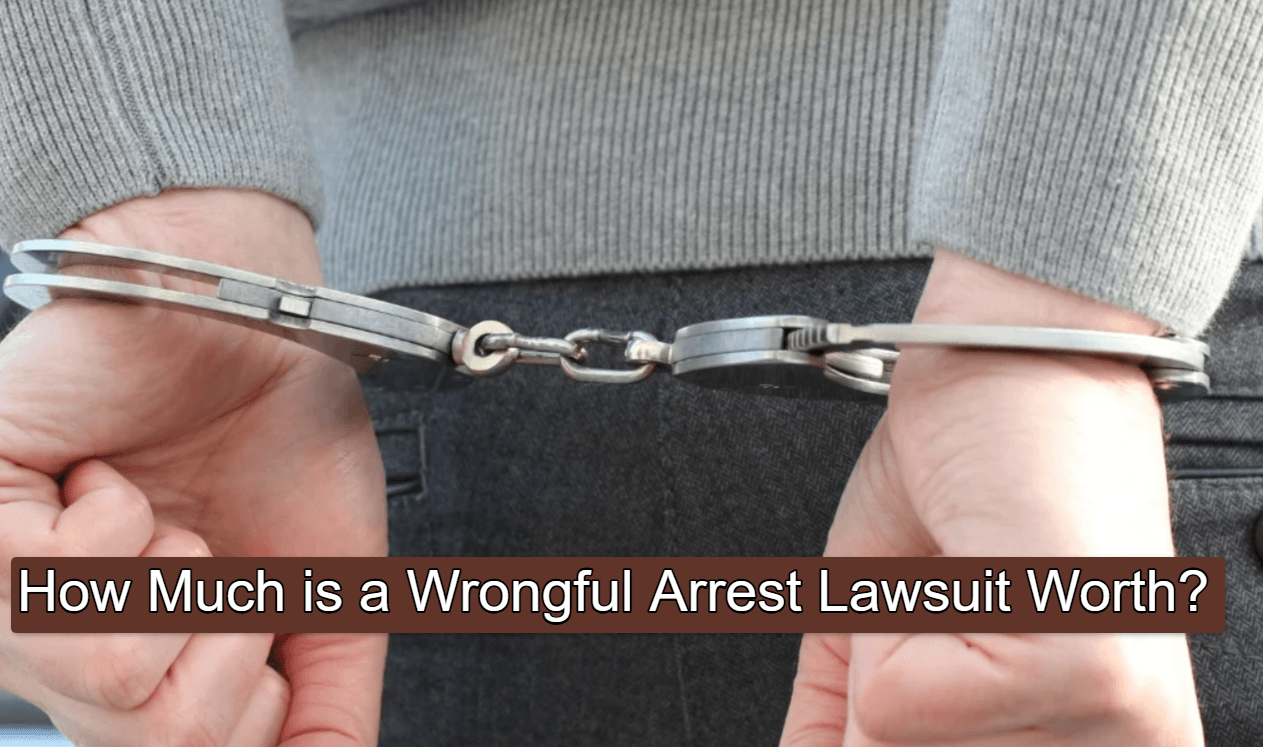
If a person is detained without a legal basis, that person may have suffered a serious injury such as loss of liberty as well as reputational damage emotional distress, loss of wages, and much more. A lot of people wonder: What is a wrongfully arrested lawsuit worth?–meaning, how much could someone be able to recover?
There’s no standard answer that fits all. Knowing the most important aspects, ranging from actual cases and the things to look out for can help determine what you can be expecting. Below is an English description of the process.
What’s a wrongful-arrest lawsuit?
- Unjustified arrest (also known as “false arrest”) is when someone is detained by the police or someone else acting under the guise of the law without probable justification and without having a warrant in place (in circumstances that require it) or on an unjustified legal base.
- The person wrongfully arrested could bring an civil suit in a claim of violation of constitutional rights (often in the Fourth Amendment in U.S. law) as well as state-law claims, such as false imprisonment negligence as well as intentional torts.
- The aim is to collect damage–money to cover the harm caused.
The legal framework
- In the Federal level most lawsuits are filed from 42 U.S.C. SS 1983. It permits plaintiffs sue state officials for violations of civil rights (including indecent arrests).
- A lawsuit can be heard in court, or often be settled via agreement (an accord between the parties).
- The courts will review evidence: whether or not the arrest was legal and whether the accused had an actual claim, and the proof of damages.
Who’s in the loop? (Who can Claim)
- Anyone within the U.S. (or in any other jurisdiction that allows similarly-themed lawsuits) that was in custody without a legal reason–in terms of the arrest did not have probable cause or was contrary to the constitutional rules.
- To file a claim in court, you must generally prove you were held, and you can show that your detention was illegal and that you suffered harm due to it (financial or emotional, reputational, etc. ).
- The longer the time in detention and the more serious the consequences, and the more likely that the claim is of significance.
Simple Timeline (How a typical case goes about)
- Arrest — The incident which led for the claim (allegedly wrong).
- Release/Dismissal of Charge Resolution -The arrest is dismissed and the charges are dismissed or the case is settled.
- Notice, demand or earlier settlement talks Most lawyers will issue a demand or notice of demand to the government organization.
- Filing a lawsuit If there is no settlement is reached, a lawsuit will be filed with the court.
- Discovery and evidence gathering Parties share documents, interview witnesses, examine bodycam footage, policies, etc.
- Settlement talks or mediation Many cases settle prior to trial.
- Trial (if necessary) — A jury or a judge determines the liability and damages.
- Appeal/final Judgment or collection — Following the trial, there might there be appeals, or efforts to recover the judgment.
What’s At Stake — What is the value
Many factors determine how much an unjustly arrested case could be worth. The more serious the evidence will be, the more potential damage.
The key factors that determine value
- Detention Length
The longer the number of hours, days or weeks you kept the more disruption and damage you could suffer. Some lawyers employ rough “hourly” estimations of damages but that’s only a small part of the equation. (Some sources suggest that a plaintiff could be charged $1,000 per hour for more complex cases.) - Economic Losses
- Income or wages lost (time you weren’t able to work during your detention, and then afterwards).
- Opportunities to work or lower earning potential when your records were damaged.
- Costs incurred (transportation, legal fees, arranging bail, etc. ).
- Non-economic Losses
- emotional distress emotional distress, mental anxiety, trauma anxiety and trauma, PTSD.
- Reputational harm Reputational damage: humiliation to the public and damage to relationships, and difficulty in obtaining future work.
- Injuries to the body or the Use of Force
If the arrest was made with excessive force, which caused injuries, medical bills which increase the value. - Nature and Level of Conduct
If the unlawful arrest was especially indecent or malicious, or if it was part of an underlying pattern or policy of misconduct, courts could decide to award the punitive damage (designed to be punishing, not to just pay). - Evidence and Proof
A strong evidence (video footage testimony of witnesses and official policies, as well as admissions of infractions) can help strengthen your case and warrant the higher amount of money you are awarded. - The Jury Jurisdiction of Judicial Jurisdiction as well as Jury Sentim
Certain courts and regions are more accommodating when it comes to civil rights issues. Jury attitude local precedents, regional precedents, as well as the culture of the judiciary are all important.
Real Examples & Illustrative Ranges
- In the case of relatively minor incidents (few minutes of incarceration, no damage) settlements can vary from the smallest amount to hundreds of thousands of dollars.
- For instance, a fraudulent arrest as well as a night’s unjust detention within New York settled at $250,000 in a single case.
- In more severe and highly-impact civil rights lawsuits, damages can be several hundred thousand, or perhaps millions.
- In long-term wrongful imprisonment cases or wrongful conviction cases the number of cases can get extremely large: e.g. the case of two defendants wrongfully convicted led to an award of $75 million to the jury (later reduced) although that case was one that involved a decade of incarceration and claims that went beyond arrest.
- In a smaller scale there are median verdicts in a few areas for false arrest or false imprisonment have been reported to be about $25,000. within Washington, D.C.
- Sometimes, the verdicts are extremely small. For instance, one Reddit user reported an award in the amount of 234 dollars for a night’s stay in a jail.
Therefore, the worth of a wrongful arrest case is highly different. What is the “right” value is contingent upon the extent of your experiences and how you can demonstrate it, and the local lawful climate.
What to Look Out For Next (Case Update and Issues to Be Watched)
- Settlement and. trial: The majority of wrongful-arrest cases settle prior to trial. Knowing the strategy of your attorney’s bargaining is essential.
- Caps and immunity Certain jurisdictions (cities or states,) have statute-based caps on damages, or have special immunity laws (e.g. the police are entitled to qualified immunity).
- Punitive damages concerns If your case is eligible, courts will examine what kind of punitive measures are appropriate within the Constitutional limitations.
- Appeals After obtaining the verdict, defendants can appeal, which could delay payment or alter an amount.
- Issues with funding and insurance: Government bodies can pay through budget allocations or insurance. collection and enforcement aren’t easy.
- Policy changes and reform The high-value awards that are awarded in civil rights cases can prompt local reforms or discussions to prevent similar situations later on.
FAQ — Quick Answers to “How Much Is a wrongful Arrest Lawsuit Worth”
Q1 Does there exist an “typical” sum of money for lawsuits involving wrongful arrest?
No. There’s no standard or average that can be used to determine the validity of a claim. Settlement or verdict amounts can vary dramatically based on the facts. For minor offenses there may be a small amount but for serious violations it is possible for values to be quite high.
Q2: What are the people who is able to claim damages from awrongful arrest suit?
An individual who was arrested without legal justification (no reason, unlawful procedure or constitutional violation) and was harmed (economic as well as non-economic) due to the arrest.
Q3 What is the impact of the time I was in detention really impact the amount I am able to get?
Yes. The longer a wrongful detention lasts is, the more damage and disruption that can occur, which generally improves the case’s worth (though other factors can also play a role).
Q4 Do I have the ability to recover from emotional stress, even if I didn’t suffer any injury to my body?
Yes. Psychological or emotional harm is usually a significant element of a claim for wrongful arrest in particular when the person was afflicted with humiliation, anxiety, reputation damage, trauma and so on.
Q5 Are there limitations or defenses that could limit the amount I am able to be able to recover?
Yes. There are limits that could be in place, including the qualified immunity (for law enforcement) limits on municipal liability or statutes of limitation (time limitations for filing) or strong defense arguments to show that the arrest was warranted.
Q6 What is the time it will take and when will I be able to see the cash?
These cases can last from up to a few years (depending on the complexity, the mediation, negotiations for settlement or a trial). If a settlement is agreed upon and payment is made, it could take several weeks or months later after a judgement or appeal, collection issues could delay payment in full.

0